
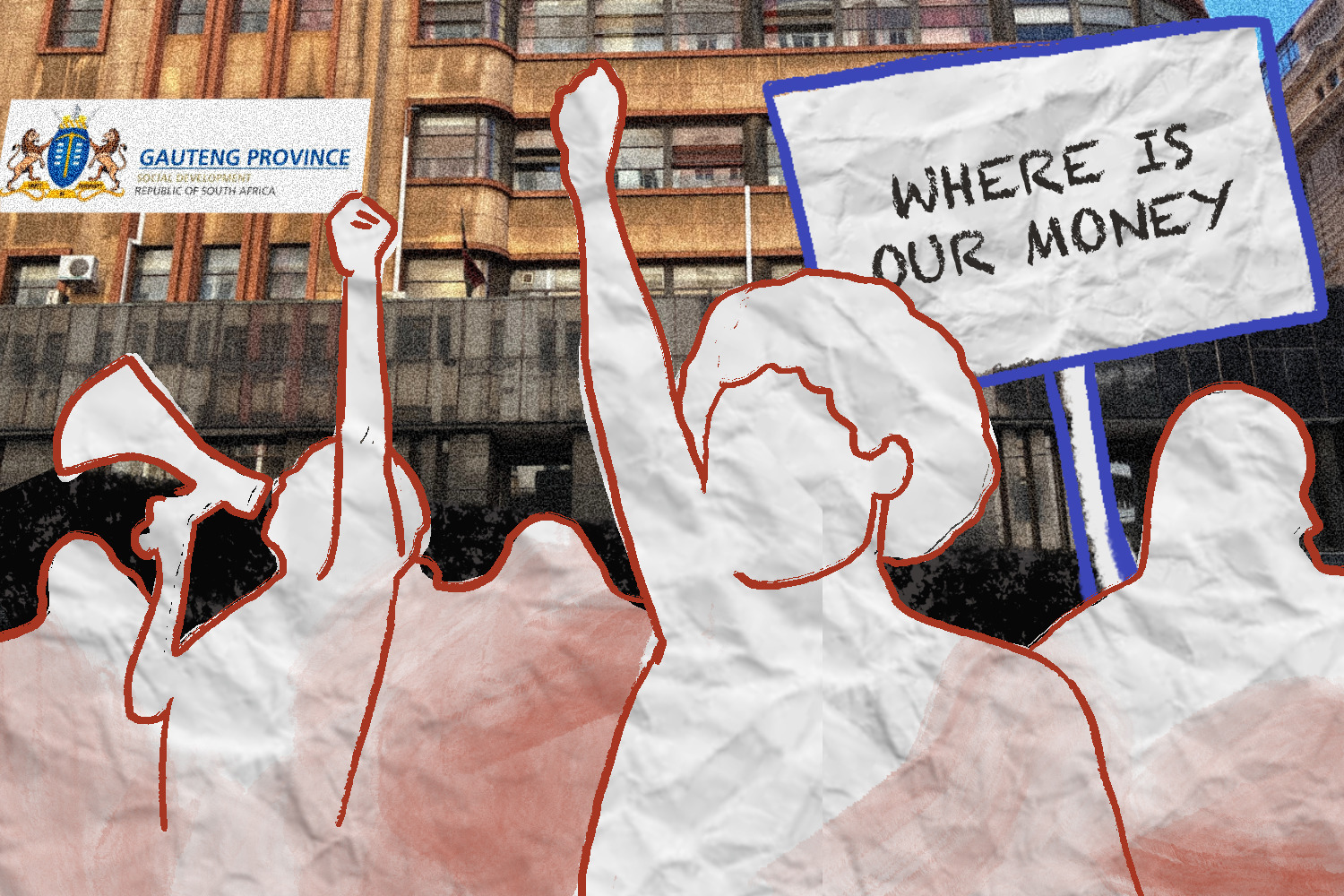
Delayed funding is leaving some organisations unable to pay their staff or sustain their services. Illustration: Lisa Nelson
- The Gauteng social development department has admitted that delays in its payments to non-profit organisations have left the beneficiaries of social work ultimately bearing the cost.
- Six months into the financial year, substance use organisation SANCA Thusong is owed R1.17-million, leaving 50 staff members without salaries and disrupting rehabilitation and social services in east Pretoria.
- Another Gauteng NGO says it has continued providing free services to victims of child abuse without funding, but can no longer sustain hundreds of counselling and court-related interventions.
Six months into the 2026/27 financial year, some non-profit organisations remain unpaid by the Gauteng Department of Social Development (GDSD).
SANCA Thusong, a rehab centre in east Pretoria, is owed R1.17-million. More than 50 staff members are in financial, emotional and psychological distress after working for months without salaries.
We spoke to social workers who said they have exhausted their life savings, received eviction warnings from landlords, incurred heavy bank charges on bounced debit orders, and resorted to high-interest loan sharks to feed their families.
Many have continued to make an effort with depleted resources, but frontline services for communities in Eersterust, Nellmapius, Refilwe, Zithobeni and Rethabiseng have been disrupted. Social workers have seen an uptick in relapses.
The organisation, which reached more than 160,000 people in 2025/26, is in arrears, with telephone lines cut off, wi-fi disabled, and threats of repossession from creditors.
After GroundUp sent questions in early September, the department said it had paid SANCA Thusong for April, August and September. But the organisation received only about R585,000, which is two months’ worth. It was later told the money covered only August and September. It has still not been paid for April to July.
In an email to SANCA Thusong on 8 September, the department’s deputy director of NPO financing said, “As soon as we receive further instructions from the programme pertaining to payment for April 2026 and possibly May, June, and July 2026 we will process the payment with the utmost urgency.”
The initial delay in GDSD funding was due to an unexplained R1.3-million worth of cuts to the organisation’s out-patient and aftercare as well as prevention and awareness programmes. The organisation successfully challenged these.
Corrected service level agreements (SLAs) had been signed on 31 July.
GDSD told GroundUp on 7 September that “the process of identifying and correcting the budget discrepancy took longer than it should have”.
GDSD previously said it had withheld subsidies because SANCA Thusong submitted no verified service statistics for May, June or July. But the organisation says its staff could not retrieve supporting records or afford copying costs after its resources were exhausted from the non-payments.
The organisation said statistics for May and June were submitted in August after it managed to get a small loan to drive to their offices and buy office supplies.
GroundUp was told the GDSD was seeking legal and executive guidance on whether it could pay for services when statistics were submitted late. It expected to resolve the matter “by the week of 11 September”. However, this never happened.
GDSD communications officer Busi Kheswa said on 29 September that internal departmental processes “are currently underway” and the outcome “will be communicated to the NPO in due course”.
SANCA Thusong head of office Elosine Aucamp said they have had no further word.
NGOs crippled by funding delays
GroundUp has reported on issues within the GDSD impacting both beneficiaries and organisations through years of mismanagement and corruption.
Once again, SANCA Thusong is not the only organisation facing prolonged delays in receiving 2026/27 payments.
In May 2026, organisation representatives protested against what they described as years of “funding injustice” by the GDSD. They protested persistent payment delays, budget cuts to competent welfare organisations and alleged lack of support.
Lisa Vetten of the Gauteng Care Crisis Committee, a coalition of non-profits, said that payment delays have crippled several other organisations providing critical services to vulnerable communities across the province.
GroundUp spoke to an organisation that has provided free child protection and therapeutic services in the east of Gauteng for the past 25 years. The organisation’s management did not want its name published, as they fear it will affect current and future funding applications.
The organisation received an official funding award letter from GDSD in March 2026, but the department had not signed the SLA and has not communicated with it.
The NGO continued providing free counselling to victims of child rape and sexual assault, and physical and emotional abuse. But the organisation can no longer sustain services without funding. This could affect hundreds of active therapeutic interventions, professional assessment reports for the police and courts, specialised court preparation and support for children.
Three-year agreements
In July 2026, MEC Nomantu Nkomo-Ralehoko promised three-year contracts spanning the 2027/28 to 2029/30 financial years to give organisations greater funding stability and reduce administrative disruptions.
The three-year SLA system was previously in place, but in October 2023, organisations were told their three-year agreements would end and that applications would run similarly to tender applications. The care crisis committee argues that dropping it contributed to the instability in the department.
The department said that the three-year model was cancelled because it did not comply with funding regulations. The department later said centralising its funding process was necessary because of corruption and fraud findings, but the auditor-general said it had made no findings on the process. Every other province in the country funds non-profit organisations on a three-year basis.
A cut to the department’s budget for non-profit organisations in 2024 coincided with over-committed contracts, leaving hundreds of organisations unfunded for months. Many were running competently and providing services for hundreds of people, but were defunded.
Years later, similar challenges remain. Many of the reasons given by the GDSD for organisations facing funding challenges in 2026/27 relate to alleged compliance issues. Some of the “non-compliant” organisations that have worked with the GDSD for years have raised concerns about the lack of support they receive from the department to become compliant.
The vulnerable pay the price
GDSD spokesperson Motsamai Motlhaolwa said in September that non-profit organisations are an “integral and indispensable” part of its social services system, with more than 1,700 programmes funded to reach hundreds of thousands of beneficiaries.
He said that delays “have consequences that extend beyond the organisation itself. When an organisation is unable to pay staff, maintain its facility or procure the materials needed to render services, it is ultimately the beneficiaries who bear that cost”.
The spokesperson said that challenges “are being addressed with the urgency they deserve” with “sped up” SLA processes, correcting internal budget errors, improving appeals and monitoring payment timelines.
Seth Thorne
groundup.org.za
