
- Communities in South Africa’s Eastern Cape are opposing a proposed heavy mineral sands mine that a South African company wants permission to operate day and night for 30 years on their communal land.
- They say the land targeted for mining is far from unused, supporting more than a 1,000 cattle, traditional medicine gathering, tourism and facilitates access to the coast and fishing.
- The villagers say that if the mine goes ahead, it will damage livelihoods, ancestral graves, biodiversity and water resources.
- The planned mine could also impact their long-running campaign to acquire commercial seaweed harvesting permits and an existing small-scale sand mining business run by a village committee.
PHOZI VILLAGE, South Africa — On a grassy mountainside overlooking the Indian Ocean on South Africa’s Eastern Cape coast, dozens of cattle graze freely. For generations, families in the small rural villages of Tyolomnqa, Phozi, and Qaga, about 30 miles from the nearest city, KuGompo, have relied on these communal lands for food, income, healing and spiritual connection.
Residents of the village say a planned open-cast mine complex spread over thousands of hectares of communal land threatens their way of life.
The Tyolomnqa Heavy Mineral Sands Project, proposed by Johannesburg-based Vendicom Minerals Beneficiation Group, is targeting zircon, rutile, ilmenite and leucoxene — heavy mineral ores used in products ranging from ceramic tiles and paint pigments to titanium for aircraft, medical implants and some renewable energy technologies.
Though, its initial application to prospect in the area was rejected by the government on procedural grounds, communications from a consultancy hired by Vendicom to conduct the environmental and social impact assessment show that the company is still keen to mine in the region. The area Vendicom is eyeing is spread across up to 18 miles (29 kilometers) of communal grazing land stretching across the Tyolomnqa, Keiskamma and Kiwane estuaries.
The three rivers, all of whose names are derived from Indigenous words, flow through rolling grasslands before reaching estuaries fringed by dunes and sandy beaches. The word Keiskamma comes from the Khoekhoe language and is commonly translated as “place of sweet waters.” For generations, rural isiXhosa communities have relied on these connected ecosystems for fishing, small-scale farming, livestock grazing and other natural resources.
A background information document initially published by the company, but then later removed from the internet, identified potential impacts including water pollution from mine waste, facilities for storing dangerous goods, and the clearing of indigenous vegetation in a Critical Biodiversity Area. The document was not an environmental impact assessment (EIA), however. The full assessment of environmental impacts and proposed mitigation measures will only come in the EIA, which will be released for public comment before authorities decide whether the mine can proceed.
The proposed mine lies less than a kilometer (0.62 miles) from the Tyolomnqa Nature Reserve and alongside the Tyolomnqa Estuary, a protected Ecologically or Biologically Significant Marine Area.
A 2025 government management plan for the estuary described it as one of South Africa’s most important coastal ecosystems, home to two mangrove forests. It flagged the presence of the Kiwani porcelain flower (Acmadenia kiwanensis), a critically endangered shrub found only between the Keiskamma and Tyolomnqa rivers, and drew attention to the 34 fish species, including the endangered white steenbras (Lithognathus lithognathus) and 191 bird species, found here. The area also features archaeological sites that include Stone Age artifacts, Iron Age settlement remains, and possibly unmarked graves.
The residents of the low-income villages of Phozi, Tsaba and Sandile catch around 40 tonnes (88,000 pounds) of fish annually in the Tyolomnqa River, according to the government document.
Community leaders said the estuary is in good condition, because they’ve cared for it and the surrounding landscape for generations. They worry if the mine goes ahead, the dust, blasting, truck traffic and changes to water flows could affect the dunes, forests, river and shoreline that support wildlife, fishing, tourism and local livelihoods.
They told Mongabay they first learned about the proposed mine when a notice appeared in the Daily Dispatch on March 24, 2026, announcing that Vendicom Minerals Beneficiation Group had applied to prospect in the area. The announcement prompted the residents to form a coalition of village committees (a unit of local self-governance), fishing cooperatives and seaweed harvesters to oppose the project.
‘Not even one piece that we are not using’
Villagers told Mongabay that mining companies generally misrepresent communal land as vacant or underutilized. On a June morning, a reporter with Mongabay accompanied Phozi village committee members on a five-hour walk over their hills as they explained all the ways they use their land.
“You can see for yourself that we use this entire piece of land in a well-organized and sustainable way. There is not even one piece that we are not using,” Phozi committee member Boneka Mema told Mongabay.
At the foot of the hills, villagers run a two-acre community mine to extract sand that is used for construction. The committee launched the mine in 2025, selling sand to nearby households and builders and reinvesting some of the profits in a school playground and the village’s first rugby field.
Drawing a distinction to the proposed heavy mineral sands project, Mema said, “we only dig up a small place and then later level that area and plant grass and indigenous plants.”
“We restore our land as we go, because it is our land, and we are proud of it,” she said.
Further up the hill, women can be seen plucking flowers, fruit and leaves from indigenous shrubs that blanket the landscape. Phozi village committee member Primrose Ndongeni told Mongabay the plants are used to make traditional medicine based on knowledge passed down through generations.
She also points to dozens of cattle grazing freely across the hills. “Those 16 there are mine. I’m a widow with four children. I don’t have money, so I support my family by selling organic [beef]. When I don’t have money for school fees, I just sell a cow,” she said.

Every morning, over a 1,000 cattle amble out of their kraals (traditional cattle enclosures placed near living quarters) to graze the communal land, according to the village committee.
“They just come to these hills by themselves, and in the evening, my brother and other men bring them home. We don’t want mining, because the shape of the land will change and there will be nowhere for our livestock to feed,” Ndongeni told Mongabay.
The mining concession could also obstruct the villagers’ access to the coast via a walking track that runs over the hills. Thandazwa Sizani, secretary of the Kiwane Fishing Primary Cooperative in the neighboring Qaga village, said residents use the route to access the beach where they swim, picnic and harvest seaweed and prawns.
“When we are short of money, we collect seaweed in buckets. One big bucket sells for $62. We also eat it for our health,” said Mema from the Phozi village committee.
“We don’t agree to be cut off from our own ocean by the planned mine,” Sizani said. “That’s why we have taken a decision not to allow mining. They want to start digging next to the beach that we use every day. We believe that mining will bring us diseases, climate change, and our sea life will die.”
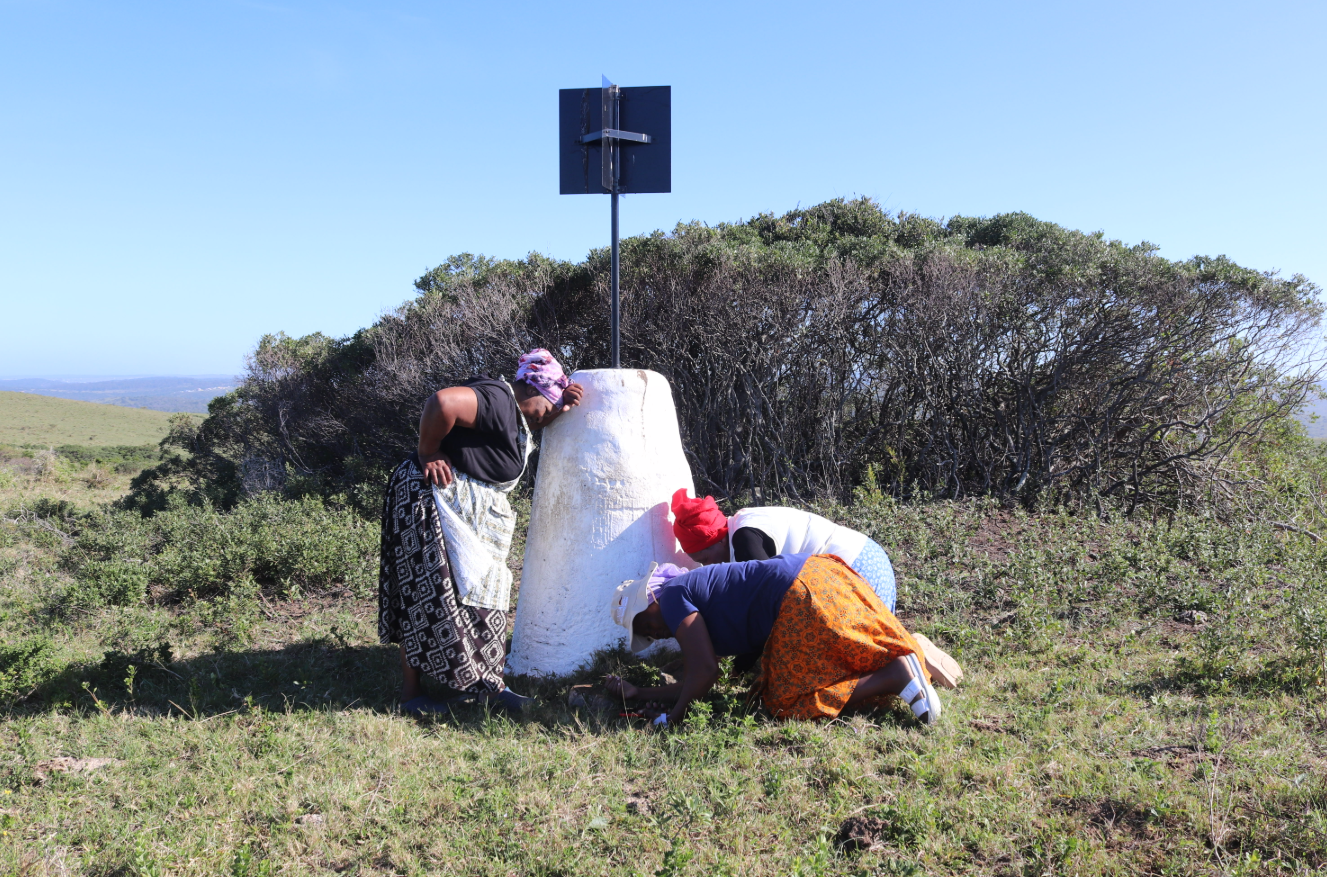
At the top of a hill, Mema, Sizani and Ndongeni stop to pray at one of the Eastern Cape’s many trigonometrical beacons, placed at the top of hills and used to survey the surrounding land, overlooking the coast. They say the beacon has become an important landmark for the communities who have co-opted it into communal life. It is now a site where villagers go, sometimes for days at a time, to communicate with their ancestors in times of trouble.
“This is our holy piece of land. There are old graves all over these hills. So that is why we come to camp and commune together with the ancestors so that we can ask them to show us the way.”

She also points out that just four miles (6.4 km) down the beach is a well-known state-owned Kiwane holiday resort, situated on the pristine Kiwane River estuary. “That resort will also be affected by the mine. Yet, it has provided employment to so many people and it has played a major part in boosting the regional economy,” Mema said.
Ayanda Yekani, chairperson of the Siyaphambili Fishing Primary Cooperative, said the neighboring village committees and fishing co-operatives also oppose the planned mine. While the co-operative’s members fish in the sea during the squid season from November to March each year, the rest of the year they rely on hunting buck in the hills and fishing in the Tyolomnqa, Keiskamma and Kiwane rivers. They fear access to these will be restricted if commercial mining goes ahead.
Another member of the co-operative, Bulelwa Paliso agreed. “We love our land. The fish are very important — our main protein at home. The mine is going to ruin everything. I can safely say that the children here will have nothing to eat if mining goes ahead.”
Otto Nozewu of the Kiwane Fishing Primary Cooperative, which works from Phozi and the neighboring Ncera village, points to livelihood opportunities that might be lost in the process. “We’ve spent years fighting to get permits to harvest and sell seaweed.”
“This is what we want, not mining. We are scared because our villages will actually be wiped out by this mine. We’ll lose our hunting; we’ll lose our herbs; and many people will be left helpless,” he said.

Fears of a heavy minerals sacrifice zone
The coalition recently launched a petition calling for the project to be halted. They have the support of the Centre for Integrated Post-School Education and Training, a lifelong education institute based at Nelson Mandela University in the coastal city of Gqeberha in the Eastern Cape province.
Irna Senekal, a researcher at the center, said the community struggle shows that global demand for minerals for renewable energy and other industries does not automatically translate into prosperity for communities where extraction occurs.
Much of South Africa’s mineral wealth lies beneath land that has been home to rural Black communities for hundreds of years. That history has made mining proposals especially contentious, with many residents questioning who really benefits from extracting the resources beneath their land.
“The communities in this area have asked, why is it only our land as Black communities that is the target for mining? This is in the context of their ancestors having experienced a 100 years of war during colonial times, living through forced removals and dispossession under apartheid and now, 32 years of post-apartheid government neglect of infrastructure, housing, water access, and other services,” Senekal said.
She added that the Phozi, Hamburg and Keiskamma area was being turned into a heavy minerals sacrifice zone. “It’s this violence and dispossession that the rural communities reject when elite power holders arrive in their area and pretend to consult them. Community members correctly analyze heavy minerals mining here as further dispossession and ecocide,” she told Mongabay. “The alternative development pathways they offer are life-giving and built on solidaristic social relations with one another and with nature.”

Diane McIntyre, an emeritus professor in the University of Cape Town’s school of Public Health, now lives in the Tyolomnqa Nature Reserve on the east bank of the Tyolomnqa estuary. She said she is also backing the Phozi village residents’ campaign against mining. “This nature reserve is in close proximity to the proposed mine and would be badly affected. Particularly, the bird and animal life wouldn’t cope with the 24-hour industrial noise,” McIntyre said.
The mining company’s background document said the proposed mine could create 800 jobs, of which 20% would be “unskilled, labourer” roles. Community members told Mongabay that Vendicom said these unskilled jobs were the only ones that local people would get, and that they planned to set up temporary structures to house hundreds of workers hired from elsewhere — an influx of people the villagers say they don’t want.
“We are asking our government to intervene and stop this mine, because it is going to cause a lot of suffering for our residents,” Mema said.
The Vendicom Minerals Beneficiation Group is a seven-year-old mining company. Mongabay found no publicly available information on its mining track record.
The executive chairman, Andile Sontundu, is also a director at Vendicom Pty Ltd, a separate company, which received a permit from the Department of Mineral Resources and Energy in June 2022 to mine a much smaller five-hectare (12-acre) area near the mouth of the Tyolomnqa Estuary for heavy minerals. This permit was renewed in June 2026. But the community said they’ve managed to prevent this mining from going ahead through peaceful protests.
The presence of two similarly named companies, which, according to a deeds search, share an owner, has raised questions among community members. Ndongeni and Mema alleged that this arrangement was intended to give the impression that mining was authorized over a much larger area than the permit covered and told Mongabay that company representatives presented the permit for the smaller area at a community meeting while stating they had approval to mine the larger area.
Mongabay obtained a letter sent by the regional manager of mineral regulation at the Department of Mineral and Petroleum Resources to the mining company on March 20, informing Vendicom that its application for obtaining a license had been rejected. According to the letter, the company had submitted two mining right applications “over the same land and for the same minerals.”
The Mineral and Petroleum Resources Development Act only accepts applications for mining rights if there is no prior application covering the same area.
Mongabay has reached out to Sontundu and Igbingie to ask whether they plan to appeal the decision or withdraw from mining the area.
Sontundu of Vendicom Minerals Beneficiation Group referred all queries to Eric Igbinigie, managing director of Assured Turnkey Solutions, a South Africa-based environmental and social risks consultancy appointed by the mining company to run the environmental impact assessment process.
Igbinigie said in an email that “the Tyolomnqa Heavy Mineral Sands Draft Scoping Report has not yet been released for public review. Consequently, the 30-day public review and commenting period prescribed in the EIA Regulations has not commenced.” The scoping report is a preliminary document produced before a full EIA is conducted.
The company has remained tightlipped about the status of its applications to mine in the area and did not respond to Mongabay’s questions about the same.
(Translations from isiXhosa to English by Chris Totobela and Sibongile Jonas).
Banner image: The village of Phozi, Eastern Cape. Image by Anna Weekes for Mongabay.
FEEDBACK: Use this form to send a message to the author of this post. If you want to post a public comment, you can do that at the bottom of the page.

malavikavyawahare
news.mongabay.com
