
Born from the rhythms, languages and everyday life of Limpopo, Lekompo is moving from taxi ranks and taverns to major stages, without sanding down the rough-edged energy that made it matter.
At a taxi rank, a wedding or a weekend gathering in Limpopo, Lekompo does not politely ask for attention. It arrives through piercing instruments, a hard, bouncing rhythm, heavy bass and voices that sound rooted in the place itself.
The beat is fast, repetitive and immediate, music built to travel through large speakers and pull a crowd into motion.
That physical force is only part of the story. Lekompo is also a statement about language, class and cultural ownership.
A sound once treated as too rural or too raw for the centre of South African pop is now supplying some of the country’s most exciting new voices.
Producers such as Hitboss SA are helping to connect established names, breakout vocalists and unknown talent, while social media, streaming playlists and live mixes carry the music far beyond the province where it began.
MULTIMEDIA BY: KATLEGO JIYANE
So what is Lekompo?
Lekompo is an electronic dance style shaped in Limpopo, but its identity comes from the way it rearranges familiar regional sounds.
The speed and melodic drive of bolo house sit alongside the communal character of tsa manyalo (Wedding songs) and the electronic experimentation associated with Shangaan music.
Amapiano’s log drum is part of the palette, although Lekompo usually pushes towards a tighter, more urgent rhythm. Sharp synthesiser phrases, insistent percussion and compact vocal hooks give the genre a sound that is direct, energetic and immediately recognisable.
Its voices are just as important as its drums. Artists sing and speak in Sepedi, Khelobedu, Tshivenda, Xitsonga and other languages heard across Limpopo.
Songs move between love, heartbreak, gossip, hardship, celebration and sharp observations about daily life.
Call and response phrases make tracks easy to claim in a crowd, while local idioms give listeners the thrill of hearing their own world carried by a modern club sound.
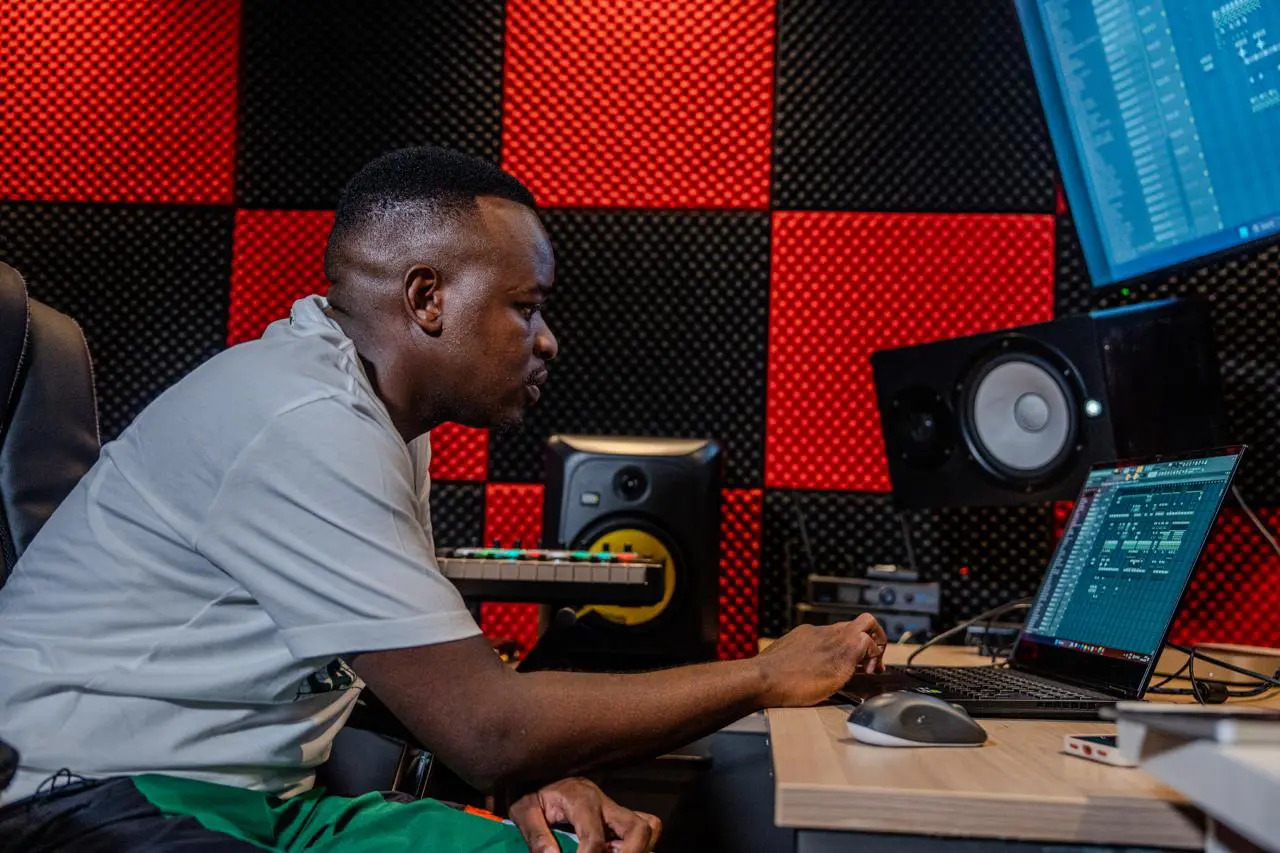
Music producer Hitboss RSA. Photo: Katlego Jiyane
From the compounds to a reclaimed identity
The name carries a difficult history. It’s artists traces lekompo to the singular of makompo, a term associated with people living in worker compounds in the farming belts of Limpopo and Mpumalanga.
Those communities were often stereotyped as poor, unrefined or uneducated. In the music, the label is being reclaimed. What was used to diminish people becomes a badge of place, resilience and authenticity.
That history helps explain why Lekompo feels bigger than a production style. It belongs to a social world of villages, farms, townships, weddings, taverns, taxi routes and family gatherings.
Its culture is participatory, dancers answer the beat, vocalists turn ordinary speech into hooks, and DJs test songs in front of people before algorithms decide whether they are hits. The audience is not merely consuming the movement, it is continually shaping it.

Revellers at the Lekompo Mix event. Photo: Katlego Jiyane
An evolution, not a sudden invention
No single song or producer can comfortably carry the whole origin story. Lekompo emerged through years of experimentation by Limpopo musicians who were already blending regional folk ideas with affordable digital production.
Bolo house established a fast, melodic electronic language, wedding music contributed communal vocal patterns and celebration, Shangaan electro demonstrated how local rhythm could sound futuristic and amapiano added a bass vocabulary that younger producers could reshape.
Early records helped establish the bridge.
DJ Call Me’s 2017 tavern anthem “Mama I’m Sorry” and DJ Lenzo’s 2020 “Pelo Ya Ka” pointed towards a meeting place between bolo house, local vocal traditions and amapiano.
Producers including DJ Spanza Man also helped shape the rhythmic template before “Lekompo” became a widely used genre label.
How the sound broke beyond Limpopo
The decisive acceleration came between late 2023 and 2025. Shebeshxt’s “Ke Di Shxt Malume” brought the sound’s confrontational street energy to a much wider audience, while Kharishma’s “Chokeslem” proved that a distinctly Limpopo record could travel nationally.
Collaborations such as “Rato Laka”, featuring Zee Nxumalo, widened the bridge to amapiano listeners without erasing Lekompo’s identity.
The route to popularity was not controlled by a single gatekeeper. DJs circulated long mixes on YouTube and at parties, short dance clips turned hooks into social currency on TikTok and other platforms, streaming playlists placed established acts beside artists recording with modest equipment, and performances gave the scene a communal spectacle.
By 2026, industry gatherings in Polokwane and Johannesburg were discussing not only Lekompo’s sound, but also royalties, publishing, branding and how to turn momentum into sustainable careers.

In the studio. Photo: Katlego Jiyane
The artists moving the centre
Hitboss SA has become one of the movement’s central producers and organisers. Born Clarence Mangena and raised in Lemondokop, he moved from dancing to DJing and production, developing a collaborative approach that treats the beat as infrastructure for other voices.
His Lekompo Balcony Mix and Lekompo Culture Chillas Mix have functioned as showcases, bringing artists, fans, promoters and brands into the same orbit.
Production work with Janesh, Abi wa Mampela and Shandesh has reinforced his role as both hitmaker and scene-builder.
He is part of a much broader ecosystem. Makhadzi and King Monada helped make Limpopo-rooted dance music commercially undeniable before the current wave had a settled name.
Kharishma, Shebeshxt, Shandesh, Janesh, Naqua SA, Kaycherlow NLL, Tribby Wadi Bhozza, Natiey Lepaka and Abi wa Mampela have each expanded its range through distinctive voices and collaborations. Women vocalists have been especially important, turning lived experience, humour and social observation into memorable refrains in a music industry that has often pushed them to the margins.
Behind the recognisable names is a restless new layer of producers, DJs and singers.
Artists such as Naleboy Young King, Memie, Tsaka RSA, Real K Mfanakota, Dolly Ditebogo, PLXYBOII_017 and others circulate through guest verses, live mixes and rapidly updated playlists.
Lekompo’s open, collaborative structure lowers the distance between newcomer and star. One compelling hook, dance challenge or well-placed feature can move an unfamiliar name into thousands of phones.

Lekompo artist Sheriff RSA. Photo: Katlego Jiyane
Why Lekompo is so popular
First, it is built for movement. The bounce is recognisable within seconds, the tempo keeps dancers engaged and the repeated hooks reward participation rather than passive listening. Even when listeners do not understand every lyric, the rhythm communicates instantly.
Second, it is proudly specific. Lekompo does not hide its accents, village references or home languages to appear universal.
That confidence gives Limpopo audiences recognition and gives outsiders something vivid rather than generic. Its local detail is not a barrier to travel, it is the source of its character.
Third, the genre is accessible to make and fast to share. Digital production tools allow young creators to build tracks without expensive studios, while mixes and short-form video let audiences discover music outside traditional radio schedules.
The result is a feedback loop, producers release quickly, dancers and DJs test the material, and successful phrases return in remixes and collaborations.
Finally, Lekompo carries both release and recognition. Its songs can be funny, blunt, joyful or bruised, sometimes within the same track.
They reflect unemployment, romance, family pressure, ambition and survival, then transform those subjects into a shared dance-floor experience. That balance, real life delivered with irresistible energy gives the music unusual staying power.
Growth brings a test
Success brings opportunity, but also pressure. For up-and-coming artists and producers such as Mkoma Saan and Moalusi, Sheriff RSA, the push to break into Lekompo’s commercial space brings these tensions into sharp focus, gaining visibility, attracting label and festival opportunities, and reaching national collaborators without surrendering creative control.
Their position in the scene highlights the need for clear contracts, publishing knowledge and fair recognition as the genre grows. Lekompo can gain reach while its creators lose out in disputes over ownership, royalties or credit.
There is also a creative risk. If the industry copies only the most obvious drum pattern, the sound could be reduced to a formula and separated from the communities that gave it meaning.
Lekompo’s rise is therefore not a story about Limpopo finally catching up with the mainstream. It is a story about the mainstream moving towards Limpopo.
The genre succeeds because it sounds unmistakably like home while remaining open to reinvention.
From Hitboss SA’s collaborative platforms to a new artist uploading a first track from a small room, the same possibility runs through the movement, local culture can set the national tempo.
Thandoluhle Ngcobo
www.ewn.co.za
