
© Lone Tree Farms“Our lead in being the only supplier of freshly harvested apples will be very short this year,” thinks Johan Naudé, chairman of the Hoogland Vrugtekwekersvereniging. At his farm, Saldanha Apples in Bethlehem, Free State, the first Gale Gala blocks have been colored for harvest.
“In the Free State we had plenty of summer rain and no significant frost incidents during flowering, and everyone is reporting a good harvest,” he says. Usually they have the apple market to themselves for a week or ten days, maybe not even this year. In the Western Cape, he says, they are hearing that Royal Gala is being harvested very early, and in the Langkloof there are reports that the drought is resulting in early ripening.
A small proportion of South African apples are grown in the Free State and Mpumalanga on a pick-pack-ship model without apple storage. “As soon as the first apples come onto the market, the price drops quickly,” says Naudé.
“In terms of prices, we are seeing similar opening prices to last year. These are good prices, but last year prices dropped quite quickly,” says Doug Osler of Lone Tree Farms in Fouriesburg, Free State. “We have seen some price growth, especially with the new genetic strains, which essentially provide better packaging and therefore better returns per hectare.”
Apple’s input costs are rising faster than its domestic selling price
Exports to the Middle East and Bangladesh are important, while trade to India has increased significantly since the relaxation of the shipping protocol. A large percentage of apples from the Free State go to the Far East, with China being the largest buyer, says Naudé.
“The export price has risen a little and the local price has risen even more. But the input costs have risen more in percentage terms than the sales price. The approach for profitable apple growing has become to achieve the highest possible class 1 percentage of the tree,” says Naudé. “The local market, as the only marketing approach, is no longer profitable because the volumes supplied are too high and prices fall too much.”
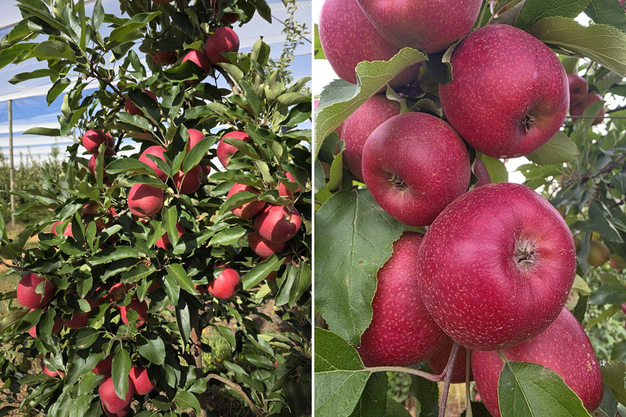 © Lone Tree FarmsSouth African cultivars Bingo Gala and Bigbucks Gala at Lone Tree Farms, Fouriesburg
The shift to the more reproductive M9 rootstock over the past decade has brought about a major change in the Free State, stabilizing volumes.
Although there is considerable overlap between the cultivars planted inland (where temperatures remain cooler and more consistent throughout the year than in the Western Cape Boland), the differences include the minor role played by the Golden Delicious, Fuji and Cripps Red cultivars in the Free State.
“We have a gap between Granny Smith, which is also our main pollinator, and Pink Lady. There are still a few blocks of Fuji left here, but we have noticed that it is not coloring as well as in the Western Cape. There are cooling problems, so we are not planting much Fuji here. There remains a gap of a few weeks before we start working with the early Pink Lady,” says Naudé. Lots of blocks of Rosy Glow and Lady-in-Red have been added, while a tough Cripps Red is producing well in their region, “but we don’t usually get good prices”.
Top Red is performing very well in their region, better than in the Western Cape, he notes, and harvest is fast because the color is so reliable (even if it is a bit of an alternative carrier). They need to be careful not to oversupply the market with Top Red.
Naudé notes that the construction of new orchards is approached in a different way than before. “Farmers have become a little more critical. In the past, we all thought we had to plant in the coldest parts of the farm, usually the low-lying areas where cold air collects. Now we look at the highest parts of the farm when planting orchards.”
 For more information:
Johan Naude
Hoogland Fruit Growers Association
E-mail: [email protected]
Carolize Jansen
www.freshplaza.com
