
In Mzansi, rice is not an indigenous crop, yet it is widely consumed across the country. This strong demand has prompted trials to test whether the soil in the Eastern Cape can support rice production.
About a year ago, the Eastern Cape department of agriculture, working with the Agricultural Research Council (ARC), began testing areas where rice could grow. The trials include upland and paddy rice in fields in Port St Johns and Mthatha. If successful, the project could improve the province’s agricultural prospects and create new opportunities for farmers to enter the rice market.
Training on grain yield reduction and its benefits for developing countries, which Ngeletshedzo Makhaga attended in China last year, inspired rice production trials in the OR Tambo District in the Eastern Cape.
How the rice trials work
Makhaga, a production scientist with the Eastern Cape department of agriculture, said part of the training required participants to prepare a country report on grain imports and exports.
“We researched grain markets and found that South Africa imports almost 100% of the rice it consumes from countries such as India, Pakistan and China,” she said.
After returning from China, Makhaga prepared a back-to-office report that included her action plan to start rice trials in the province.
“My action plan was to source rice seeds and start trials. At the time, Mrs Babalwa Mpambani was acting as the director in our section. She and Mr Mongezi Moyake, the deputy director in my district, helped me search for seeds until we eventually partnered with the Agricultural Research Council,” she said.
The project focuses on planting 140 different cultivars from Japonica and Indica parent material of upland rice. Some trials are under irrigation systems, while others are being conducted under dry-land conditions.
Related stories
Makhaga said they also tested summer rice cultivars, which take about four months to mature. So far, the first season has shown promising results.
“Twenty-three cultivars have shown early maturity in Port St Johns, and we started harvesting on 3 February. In Mthatha, the plants only started heading in late February,” she explained.
The first trial was planted in October 2025 and placed strictly under irrigation, receiving water twice a week for an hour. “This helped our trial survive the drought spell,” she noted, adding that soil conditions also influenced how the rice performed.
Port St Johns has clay-rich soil, which helps the rice thrive because it holds water and nutrients for longer periods. In contrast, soils in Nonkobe near Mthatha are sandy loam, which drain quickly and have a lower water-holding capacity.
This affected the Nonkobe trial, where a limited water supply delayed head formation. Makhaga said Port St Johns is proving more advantageous than Nonkobe, as the rice planted in Nonkobe has not yet matured.
Rice project set to feed and employ
Timmy Baloyi, a biotechnologist specialising in plant breeding at the ARC, says the rice trials are currently planted on farms, with farmers managing them under the guidance of the department of agriculture.
He explained that the project has hosted information days where farmers from surrounding areas were trained in rice production.
“Land Bank started working with us in 2019, providing expertise to develop a funding model that can be implemented should the project succeed,” he said.
He noted that the team contributed to a visibility study, identifying strengths, weaknesses, opportunities, and threats across the entire rice value chain.
“We also collaborated with the National Agricultural Marketing Council (NAMC), which provided insights on rice importation, the types of rice that can be imported, pricing, and other market-related issues,” Baloyi said.
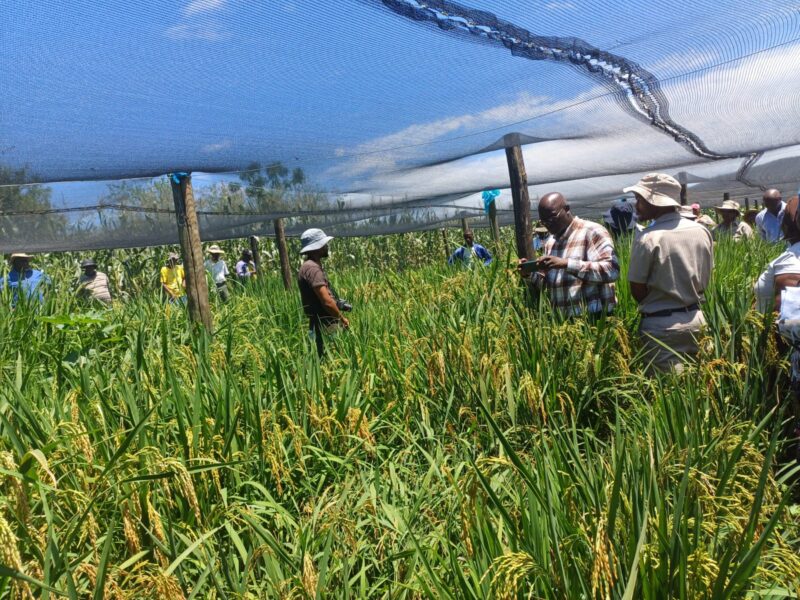
Universities are also involved. A University of Pretoria student conducted a study on a specific rice cultivar to understand its behaviour. Partnerships have also been established with the University of KwaZulu-Natal, which will provide technical support, and the University of the Free State, which will focus on quality aspects.
Farmer organisations, Baloyi said, play a crucial role in ensuring farmers receive proper training and information in rice production.
The ARC is handling the economic aspects, bridging gaps, developing suitability maps, assessing cultivar adaptation, and overseeing research and development activities.
“It could have a major impact on daily dietary requirements and contribute to broader food security. Thousands of jobs have been created through those commodities, and we expect similar opportunities with rice,” he said.
Makhaga said the trial will run for two years, until 2027. After this year’s harvest, they will report the project’s performance.
READ NEXT: Failing farms: Collapsed state projects trap EC farmers in debt
Vateka Halile
www.foodformzansi.co.za
