

Volunteers clean up an illegal dumping site in Soweto as part of the Soulbent Project. Photo: Seth Thorne
- The Soulbent Project has more than two dozen Soweto residents clean the streets.
- The project also converts dumping sites into vegetable gardens.
- As Johannesburg struggles with inconsistent and inadequate refuse collection, illegal dumping in public spaces has become widespread.
- Pikitup, the city’s waste utility, has allocated R115-million to address illegal dumping at more than 2,000 hotspots.
From Monday to Friday in Soweto, Johannesburg, more than two dozen residents, including teenagers and pensioners, move through the streets with tongs and rubbish bags to clean the neighbourhood. They are members of the Soulbent Project, a non-profit organisation.
“Our communities are being taken over by rubbish,” says resident and volunteer Winnie Sambo.
What started as a small family effort in 2008, founded by siblings Mashudu, Millicent, and the late Tshifhiwa Makhado, in Atteridgeville, Pretoria, has grown into a movement of hundreds of residents.

Soulbent CEO Mashudu Makhado says they operate in several parts of Gauteng and recently clean in Ratanda and Sebokeng.
Illegal dumping has become a widespread problem across Gauteng. Makhado blames a breakdown in waste management services and inconsistent refuse collection that leaves residents dumping waste in public spaces.
Apart from litter collection, Soulbent converts dumping sites into community vegetable gardens, growing crops such as spinach and onions. Besides providing food for vulnerable residents, the sale of vegetables helps fund equipment, such as wheelbarrows and refuse bags.
Despite their positive impact, Makhado says, “Municipalities don’t see us as part of the solution, but competitors.” He says it often happens that municipal waste collectors arrive after volunteers have already cleared and bagged the garbage.
The Gauteng Department of Environment has provided some support, though not through any formal agreement. Spokesperson Andrew Mathabathe said assistance includes cleaning and protective clothing, and some Soulbent members have been recruited into the Expanded Public Works Programme. Mathabathe said the department appreciates Soulbent’s community-focused efforts.
Illegal dumping accounts for about 22% of all waste handled by Pikitup, excluding general litter managed through street cleaning.
Experts have warned that many Gauteng landfill sites are nearing the end of their operational lifespan, with insufficient planning for new facilities. In Johannesburg, only two landfill sites are currently fully operational.
Pikitup’s 2025/26 business plan allocates R115-million to address illegal dumping and identifies more than 2,000 hotspots. However, it acknowledges that significantly more funding is needed.
At the same time, Pikitup’s budget is declining, from R1.21-billion in 2024/25 to R1.19-billion in 2025/26, with further reductions projected, R1.14-billion in 2026/27 and R1.12-billion in 2027/28.
Makhado says a long-term, strategic approach to waste management is needed, or South Africa risks being “consumed by litter”.
He says the work should not be treated as temporary labour, but as work that requires skills and education.
Makhado is calling for sponsorship or donations of essential equipment, including gardening tools, refuse bags, gloves, litter pickers, masks and sun hats.
The City of Johannesburg did not respond to our request for comment.
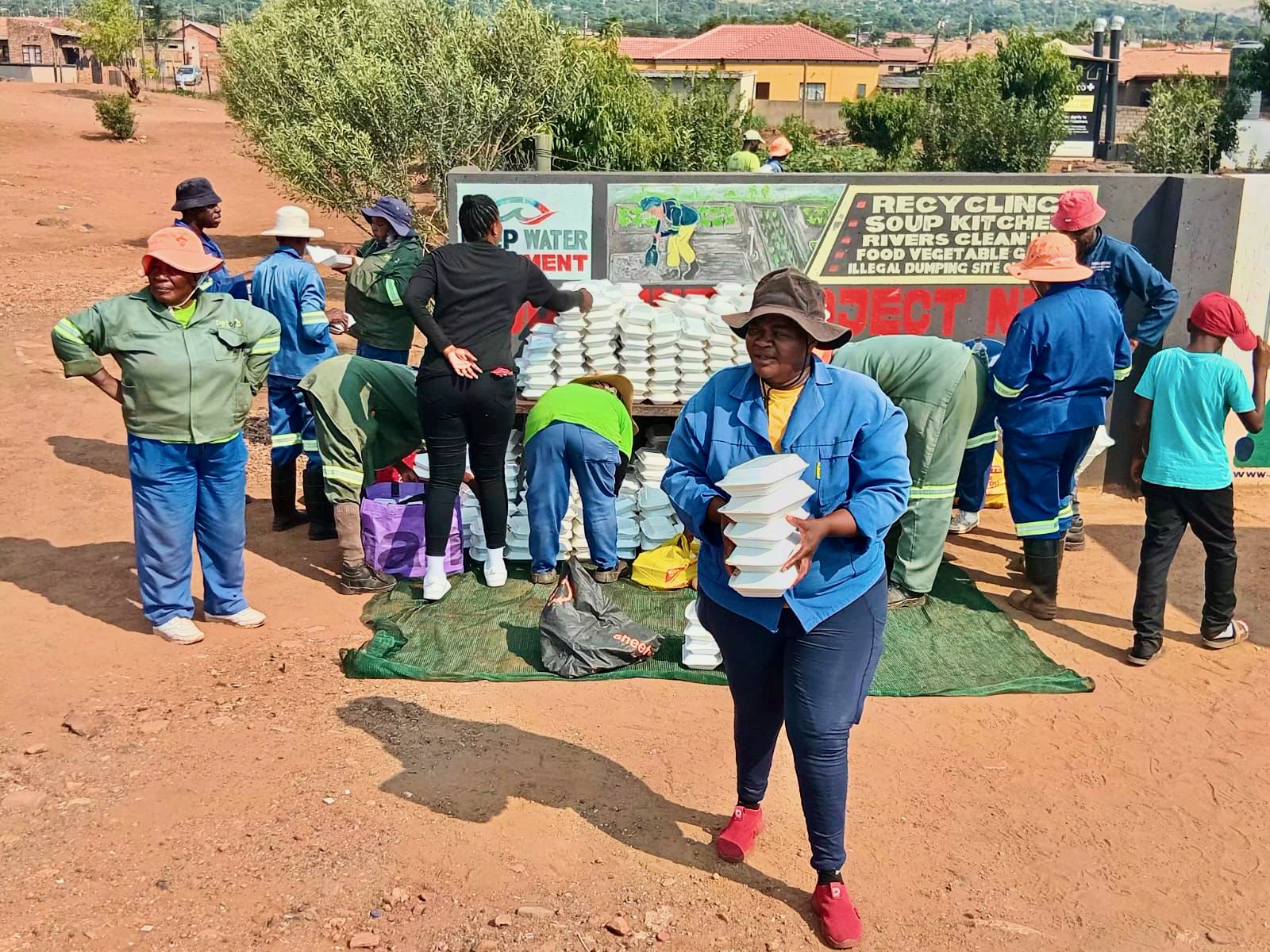
Food distributed from the Soulbent project in Pretoria. Photo supplied
© 2026 GroundUp. This article is licensed under a Creative Commons Attribution-NoDerivatives 4.0 International License.
You may republish this article, so long as you credit the authors and GroundUp, and do not change the text. Please include a link back to the original article.
We put an invisible pixel in the article so that we can count traffic to republishers. All analytics tools are solely on our servers. We do not give our logs to any third party. Logs are deleted after two weeks. We do not use any IP address identifying information except to count regional traffic. We are solely interested in counting hits, not tracking users. If you republish, please do not delete the invisible pixel.
By Seth Thorne
groundup.org.za
