
- Since 2004, the South African government has been working to restore spekboom thickets in a semiarid region of the country.
- This biome, anchored by the hardy, carbon-sequestering spekboom plant, has been massively degraded by two centuries of expanding farming and livestock herding.
- That long arc of conversion of thicket landscapes to farm and rangeland is now dying, as overgrazing, climate change and shifting markets for agricultural products take their toll.
- Dozens of private operators have joined the government in trying to restore this biome’s original thicket cover, attracted by the potential for income from carbon credits.
“Spekboom is everywhere, it’s all anyone talks about … what used to be an Angora goat farming town is now a spekboom town,” says field ecologist Rae Attridge. In the past two years, Nat Carbon, the carbon project developer Attridge works for, has planted 10,000 hectares (nearly 25,000 acres) of spekboom in the Klein Karoo, a semidesert region of South Africa.
Their work is the first phase of an effort to restore 100,000 hectares (250,000 acres) of degraded land on five farms near Jansenville in Eastern Cape province. The company is one of more than 60 entities carrying out spekboom thicket restoration projects across 800,000 hectares (2 million acres), all loosely tied up under what the United Nations calls the Thicket Restoration Movement.
The Subtropical Thicket Restoration Programme was started in 2004 by the South African government with $8 million of funding intended to catalyze large-scale investment into thicket restoration efforts in the region. These were the first green shoots of a growing collection of projects now recognized by the U.N. In 2009, researchers had planted spekboom (Porticularia afra) on 331 quarter-hectare plots scattered across over roughly 7.5 million hectares (18.5 million acres) of the biome to evaluate the potential for restoration.
These earlier experiments found that thicker stems would increase survival rates, but watering at planting time had a negligible impact. It also found that animals, both wild and domestic, easily found their way to these small poorly protected plots.
‘The sky’s the limit’
Degradation of the thicket biome is primarily the result of nearly 200 years of overgrazing of the landscape. As goats ate away the spekboom, it allowed rains to wash away the top soil, turning these once lush ecosystems into barren wastelands. Approximately 80% of the natural thicket had been degraded.
Three years ago, according to Robbert Duker, spekboom scientist and project director at climate consultancy C4 EcoSolutions, government efforts to restore the Klein Karoo’s thickets extended over perhaps 2,000 hectares (nearly 5,000 acres). He now estimates that figure to be about 30,000 hectares (74,000 acres). Private developers have replanted spekboom across an additional 25,000 hectares (62,000 acres).
“It’s ramping up quite quickly, the sky’s the limit,” Duker said.
That pace is set to accelerate further after the United Nations Environment Programme (UNEP) recognized thicket restoration as a World Restoration Flagship under the U.N. Decade on Ecosystem Restoration.
“One of the things was just how special it is, how unique it is … the potential also for restoration activities to go forward and the impetus that’s already behind it,” said Salman Hussain, coordinator of The Economics of Ecosystems and Biodiversity initiative at UNEP. “The biodiversity benefits of thicket restoration are extremely high as well.”

Funding restoration
Duker estimated that $75 million has been raised for these efforts by the private sector. Government funding is also in the tens of millions range.
Because of spekboom’s potential to store carbon in its leaves, roots and the soil it covers, carbon credits have long been seen as a potential source of funding for this work. Carbon markets tumbled after 2022 in the wake of questions about their credibility. One large project in Kariba, Zimbabwe — whose credits had been verified by the world’s largest carbon credit verifier, Verra — was found to have overstated its carbon reduction benefits by 15 million metric tons. Verra cancelled 10 million verified credits that had been issued and retired, and 5 million more that had been purchased from Kariba project owner Carbon Green Investments and were still on the market, inviting their current owners to voluntarily cancel them.
Carbon prices have recently stabilized, and more verifiable projects can more easily be distinguished from weaker ones. Reports from the U.N. and the OECD say carbon credits that have been verified by third parties and focus on permanent carbon removal that would not have happened without the project seeking credits are typically considered stronger.
UNEP recognition should also help attract carbon market funding for thicket restoration.
“When investors are looking at this and they know that thicket is one of the [U.N.] flagships, it basically means there’s more credibility,” Hussain said.
Carbon credits are not the only funding available for restoring spekboom thickets. In 2023, carmaker Volkswagen, a major employer in Eastern Cape province, joined other partners to support a thicket restoration project at Sand River Sanctuary, operated by EcoPlanet Bamboo, a developer of bamboo plantations and reforestation company. The project has expanded to include a neighboring farm. So far, they’ve planted 3,000 hectares (7,400 acres) with spekboom.
Camille Rebelo, co-founder of EcoPlanet Bamboo, said the aim is to develop 10,300 hectares (nearly 25,500 acres) as a permanent conservation area rather than to sell carbon credits. “We have a requirement with our buyers to put these lands into permanent conservation areas, because otherwise if carbon markets drop there’s nothing to stop sheep and goats coming back,” she said.

With so many organizations planting spekboom independently without an umbrella structure or entity, coordination has proved a challenge. In some cases, Duker said, thicket restorers are working in silos, unaware of how others may have solved a problem they’re facing. “One implementer may have developed some protocols for planting that increase survival or decrease the likelihood of a goat finding the plant that’s been put in the ground, while another developer could be doing the same thing right next door,” he said.
Other observers expressed concern that the entry of so many new initiatives risks damaging the landscape in the name of restoration. “Unfortunately private companies have started out and they just go in and plant spekboom at 100% density, which we are dead against,” said Jan Vlok, research associate with the Rhodes Restoration Research Group.
Overplanting like this could shade other succulents and plants and in fact ruin the biodiversity that they provide. “That’s not restoration, that’s forestation. That’s a very bad thing,” Vlok said.
He said that while companies can currently plant however much spekboom they like, the maximum coverage should be 70-80%, or even as low as 10-15%, depending on the specific conditions of a site. Vlok called on the government to put measures in place to prevent what he terms “the sharks coming in,” attracted by the promise of easy profits.
Duker expressed more confidence that safeguards already in place are enough to ensure there’s no net biodiversity or community harm. Spekboom projects, he said, generally adhere to the Climate, Community & Biodiversity (CCB) Standards, a set of guidelines developed by Verra to ensure climate change mitigation projects avoid harm while delivering tangible climate and biodiversity benefits.
He acknowledged the debate over the appropriate density of planting spekboom, noting that if developers plant at inappropriately high densities, there will be attrition.
Hussain said one of the reasons UNEP chose to recognize the restoration projects collectively was to try to strengthen coordination of these entities.

This part of the Klein Karoo used to be a thriving farming community centered on mohair wool from herds of Angora goats. But added global competition in its production, and extended drought affecting the Karoo have devastated the industry and the communities that depended on it. Now, unemployment in these towns can reach 80%.
Nat Carbon’s labor needs vary, from short-term work on teams planting and harvesting spekboom, to more specialized, sustained employment working in the nursery and putting up fencing. While most of the jobs are seasonal, the company plants spekboom for as much as 10 months of the year, hiring as many as 1,500 people through contracts with roughly 50 small businesses.
Part of Attridge’s job is to survey the local communities to understand Nat Carbon’s social impact. She found one individual who worked on a project in a harvesting team, and who now has his own business and is in charge of a team of spekboom planters. She acknowledged that hiring workers through contractors puts an extra layer of separation between Nat Carbon and the employee, sometimes causing problems arising, such as paying the right amounts and on time.
Attridge said all the workers earn at least the minimum wage — 30.23 rand an hour, or about $1.90, in March 2026 — which compares favorably with the hourly rate of 16.62 rand ($1.05) paid by the government’s Expanded Public Works Programme. (The EPWP is a government initiative that offers temporary work to unemployed people in places like Jansenville, and is exempted from paying the legal minimum wage.)
Duker said workers can earn anywhere between one and a half to double what they would make as a herder due to incentives that companies have around things like amount of spekboom planted.
EcoPlanet employs roughly 300 people in spekboom planting. Co-founder Rebelo said she expects there will be planting jobs for the next decade, but also aims to create jobs that last beyond the length of the project.
The company has set funding aside for a 30-year commitment to the community, aiming to develop social enterprises that so far include a bakery and a dressmaking project.
And the company is not the only spekboom operation trying to facilitate community benefits beyond employment. “One project is putting money into schools [buying] books, laptops, infrastructure upgrades,” Duker said, noting how money being invested in these projects is working to rejuvenate communities in desperate situations.
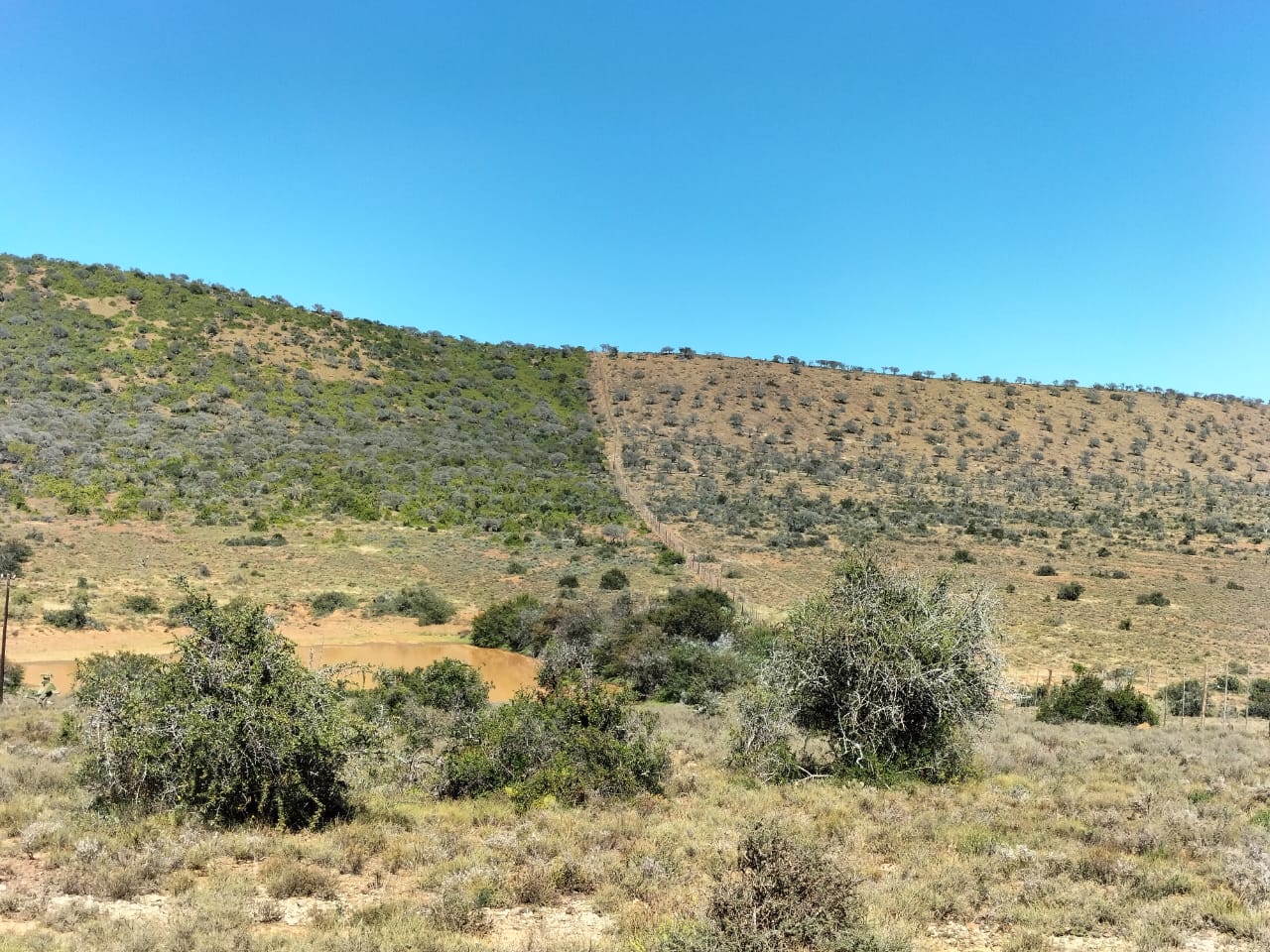
From the landowners’ side, there are a couple of factors bringing them to thicket restoration. The first is the money. Duker estimated that a farmer can rent land to a developer looking to restore thicket for $10-$20 per hectare (about $4-$8 per acre) per year. Some developers have instead offered farmers a percentage of profits from carbon credits when they’re sold later on, say 10%. Duker noted that roughly 75% of farmers he’s talked to opt for a hybrid of the two.
Sheep farming is under immense pressure in Jansenville and similar towns. Since 2021, stock theft has gone from the odd sheep being taken, to professional rustlers arriving with pack of dogs to herd sheep into trucks to take them away.
Meanwhile, degradation of the land through centuries of sheep farming, increasing droughts and erratic rainfall means the land can’t support as many sheep as it once did.
Many farms have responded to the degradation by reinventing themselves as private game or hunting lodges. Rebelo said this has created additional problems when free-ranging herbivores such as kudu drift off game reserves into stands of young spekboom saplings and destroy them.
All of this plays out against a backdrop of high inflation that has increased the cost of maintaining fences — frequently damaged by rustlers — and of fuel and vehicles and general operating costs.
Both thicket coverage and regional prosperity are a long way from what they once were, but the UNEP recognition is one more step to spekboom restoration and job creation, proponents say.
Banner image: At work in NatCarbon’s spekboom nursery. Image © UNEP/Todd Brown.
Can wonder plant spekboom really bring smiles back to sad South African towns?
Citation:
Mills, A. J., & Cowling, R. M. (2006). Rate of carbon sequestration at two thicket restoration sites in the Eastern Cape, South Africa. Restoration Ecology, 14(1), 38-49. doi:10.1111/j.1526-100x.2006.00103.x

Terna Gyuse
news.mongabay.com
