
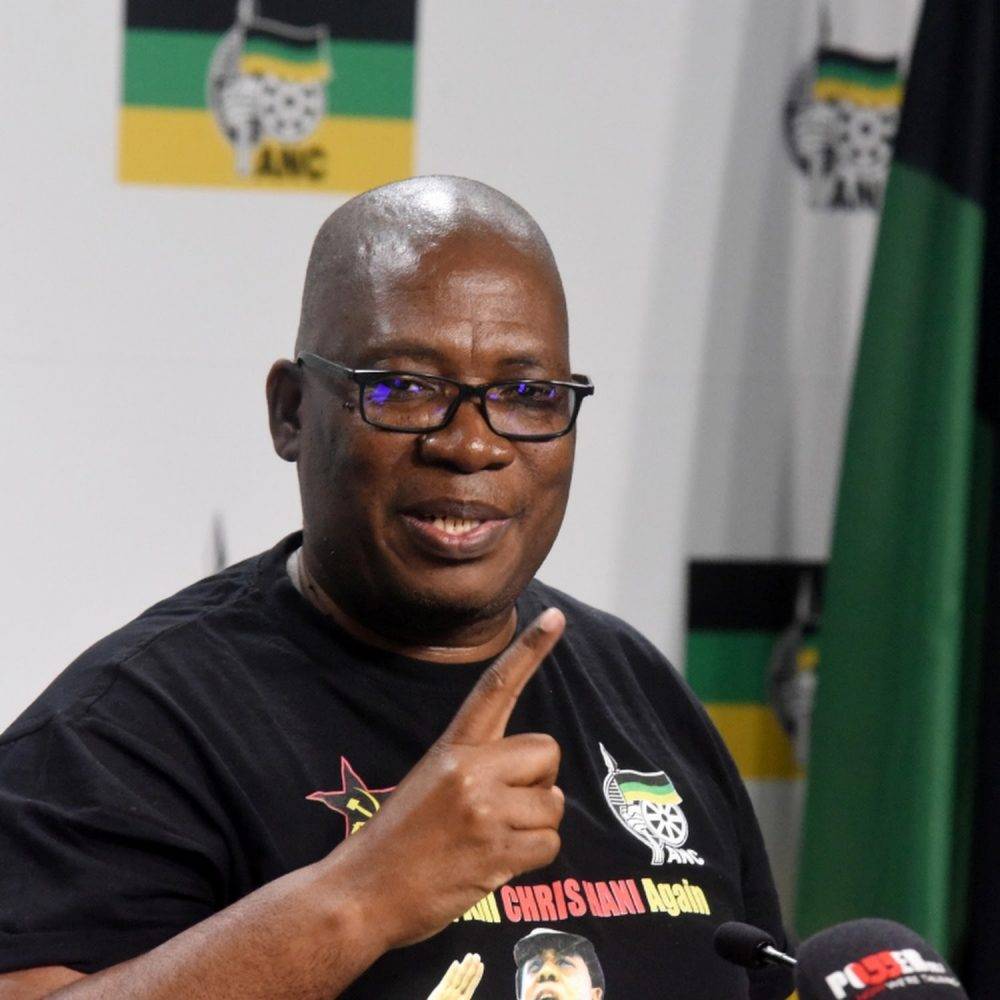
Gauteng Premier Panyaza Lesufi.
Ironically, while farmers battle outbreaks of foot-and-mouth disease that threaten livestock and food security, Gauteng has been battling its own epidemic: politicians who repeatedly put their “foot in their mouth”, with consequences that contaminate public trust.
Panyaza Lesufi’s recent comment that he too is affected by water shortages and is sometimes “forced” to shower in a hotel could hardly be a more glaring example. Intended, perhaps, as empathy, it instead exposed a profound disconnect between leadership and the lived reality of the people. For residents queueing at water tankers and storing water in buckets, the Premier’s solution sounded less like solidarity and more like satire.
This moment was not an isolated misstep. It belongs to a longer pattern of populist performance and careless rhetoric that has steadily eroded the African National Congress’s (ANC) standing in Gauteng. Over time, this governing style: loud, impulsive, and theatrically engaged has come at a steep electoral cost.
Gauteng should, in theory, be the ANC’s safest political stronghold. It is South Africa’s economic engine, home to capital markets, industry, skills and the largest concentration of urban voters. For decades, it underpinned the party’s national dominance and symbolised the successful transition from liberation movement to governing authority. Today, however, it has become the ANC’s most unforgiving mirror: a province that has withdrawn its consent to be governed by spectacle rather than substance.
The numbers tell the story. In 2009, Nomvula Mokonyane inherited Gauteng at its electoral high-water mark, with the ANC commanding 64.04% of the provincial vote. By the end of her term in 2014, that figure had fallen sharply to 53.59%, a loss of 10.45 percentage points in a single cycle. David Makhura who took over after her, between 2014 and 2019, significantly slowed down the decline, with support slipping by approximately 3.4 points to just above 50%, while Lesufi’s accession after Makhura in 2022, collapsed this fragile stabilisation.
By 2024, the ANC had plummeted to 34.76%, a catastrophic loss of more than 15 percentage points. Analysing these closely connected leadership epochs is sound precisely because they involve largely the same electorate operating under similar socioeconomic conditions. The voting pool did not fundamentally change; what changed was how power was exercised under these three leaders. The resulting patterns reflect not demographic shifts but the cumulative electoral consequences of leadership style and political conduct.
Two names dominate this trajectory: Mokonyane and Lesufi. Different individuals, similar political instincts. Both cultivated high visibility. Both favoured grand performance over institutional discipline. And both repeatedly demonstrated a troubling tendency of putting their “feet in their mouths”; speaking before thinking.
Mokonyane’s tenure was defined by spectacle: bold announcements, public spats and headline-grabbing interventions that rarely translated into sustained delivery. Township renewal projects stalled. Economic initiatives fizzled out. The Alexandra Renewal Project became shorthand for waste and opacity.
Her infamous “dirty votes” remark implying that poorer communities were electorally inferior, crystallised this governing approach. In a single careless phrase, frustration turned into alienation. Voters heard not empathy but disdain.
More than a decade later, Lesufi’s hotel-shower comment followed the same pattern. Like Mokonyane’s remark, it revealed how quickly performative politics slips into tone-deafness. Both moments exposed a political elite increasingly insulated from the material conditions of the majority. The symbolism matters. When water fails, electricity falters and infrastructure decays, words carry weight.
Between these two eras lies a revealing contrast. Makhura’s premiership coincided with slower electoral decline. He did not dominate headlines. He did not govern through slogans and theatre. Instead, he emphasised administrative order and institutional process. His approach appeared grounded and voters responded not with enthusiasm but with relative patience. In Gauteng’s volatile political landscape, restraint proved electorally valuable.
Lesufi’s ascent marked a return to high-volume politics. Governance became increasingly performative: livestreamed inspections, hashtags, staged interventions and cinematic launches. Expectations soared. Delivery lagged.
Youth employment initiatives such as Nasi iSpani and iCrush No Lova were presented as transformative while in practice, they became associated with short-term contracts, stipend delays and uneven execution. Crime-fighting programmes were announced with urgency, budgets expanded and departments centralised, yet residents experienced little sustained relief.
Each announcement raised hope. Each failure deepened cynicism.
In a province with extraordinarily high youth unemployment, this cycle is not merely inefficient. It is corrosive. It turns governance into a revolving theatre of promises without permanence.
This cycle of over-promising and under-delivering is compounded by the visible culture that surrounds it. Lesufi’s remark about resorting to hotel showers during water shortages was not an isolated lapse of judgment but a revealing window into this broader political environment. It reflected how easily personal comfort is normalised within leadership circles, even as ordinary residents improvise daily survival. As governance becomes more performative and less effective, public office increasingly appears to function as a gateway to insulation from hardship.
Politically connected individuals routinely display luxury travel and elite lifestyles on social media, projecting images of comfort and privilege in a province marked by service failures and economic anxiety. In this context, excess is not merely tasteless; it becomes further evidence that political performance has replaced public service. Each display of indulgence reinforces the perception that slogans and livestreams mask a deeper moral and administrative decay.
The consequences of this erosion of trust extend beyond the ballot box. As confidence in provincial governance weakens, Gauteng has experienced sustained semigration by businesses, professionals and affluent households, particularly toward provinces perceived to offer more predictable and disciplined governance, like the Western Cape. This is not ideological migration driven by party loyalty but administrative migration; a rational response to a governing environment that feels ad hoc, uncertain and unreliable. When leadership communicates impulsively, governs theatrically and manages inconsistently, those with economic mobility respond by relocating their lives and capital elsewhere.
What unites Mokonyane and Lesufi is a shared governing logic: populism combined with impulsive communication. Both conflate visibility with effectiveness. Both rely heavily on theatrical appeal. And both underestimate the long-term damage of careless speech.
In an era of permanent connectivity, every sentence is amplified and archived. Every misstep becomes political evidence. And in Gauteng, voters have been paying attention.
Urban voters navigating potholes, water outages, transport breakdowns and crime are not impressed by theatrics. They want institutions that function.
Yet the ANC continues to elevate figures whose primary political skill is commanding attention and negative headlines rather than building capacity. Leaders like Mokonyane and Lesufi are not merely flawed communicators who occasionally misspeak. They embody a governing culture that privileges performance over planning, visibility over verification, and emotion over execution. This culture repels voters because it signals instability, superficiality and indifference to lived reality. In doing so, such leaders become structural liabilities to the party, reliable generators of controversy, alienation and electoral decline, and enduring gifts to the opposition.
Gauteng has become the place where ANC slogans go to die. Until the party abandons its addiction to populist performance and cultivates disciplined, credible administrators, its decline will continue.
Farmers know that foot-and-mouth disease spreads rapidly and devastates herds if not contained. Political foot-in-mouth disease works the same way. Left untreated, it destroys credibility, weakens institutions and drives voters away.
The electorate has delivered its diagnosis repeatedly. The question is whether the ANC is prepared to accept the treatment.
Muzi Zulu is a citizen in Gauteng
Eyaaz
mg.co.za
